Body Singing by Breck Alan

Nashville and Online Vocal Coach

  • About Body Singing
    • Find Your Unique Voice
    • Who I Work With
    • Testimonials
    • The Need for a Voice Teacher
    • My Vocal System
    • Balance in Vocal Study
    • Vocal Chiropracty
    • Vocal Master
    • Building Blocks of Vocal Technique
    • Things Grow up Together
    • Build Your Voice Like an Instrument
    • Rants & Questions
    • Breckisms
  • Voice Instruction Services
    • Online Voice Lessons
    • Private Voice Lessons
    • The Art of Body Singing Digital Download
    • Vocal Warm Up CD
    • What does a vocal teacher do?
    • Articles on Singing
  • Breck Alan
    • Qualifications and Affiliations
    • Songwriting
    • Songs
    • Recording
    • Six Months of Singing Program
    • Photo Gallery
  • Free Voice Lesson Videos
  • Singing Blog
    • YouTube Rants
      • Contact
  • Online Lessons & Digital Store

Why it’s crucial to budget ahead of time for vocal production

July 21, 2019 by Breck Alan

Are you working on a new album?

With all of the expenses associated with music production, singers often forget one of the most important budget items.

I would say a huge percentage of what I do is vocal production. Either months, weeks, days, or hours ahead of time, singers contact me to work on songs they’re about to record or perform, or both.

The idea is to go through songs and find ways they can be improved, either technically, artistically or both.

This can produce some very tangible and desirable improvements. We sometimes get in a groove that doesn’t want to budge, and sometime it takes an outside force to help us see the way over to something freer, more powerful, more communicative, or all of the above.

I don’t have an agenda for singers and want to help in any way I can, but I will say that the further ahead of time you can go through the process of examining, adjusting and rehearsing changes the better. In many cases I can demonstrate some desirable changes that aren’t necessarily going to be possible immediately. You’d like time to work through the techniques involved to reach these changes and be natural and genuine with them.

We want to be in a place where our intention guides our singing, but there are times we have to lock ourselves in a room with some new ideas and approaches and make them our own. There might be some struggle involved in that process and even though certain types of energetic struggles can be desirable in performing, fighting technique, is rarely attractive.

Waiting until the day of recording and having a producer start requesting difficult changes in your singing is more than likely only going to cause frustration, and we’ll hear that in the song.

So do yourself a favor, and budget some time and money ahead of time to do some Vocal Production for your project. Working with someone that has years of experience and some technical skills to teach you the steps to attain your goals, will prove invaluable not just for this project, but will leave you at a higher level of expertise for the next project and the performances of the material you’re about to record.

Here’s to thinking ahead.

Have fun,

Breck Alan

Filed Under: Articles on Singing, Singing Blog Tagged With: recording vocals, vocal performance

Hum The Mood

May 9, 2018 by Breck Alan

Voice Expression

Does your tone Stand out as unique?

Can you hear the mood and emotion in your singing tone? 

Does your singing tone match the emotional content you’re trying to convey, or is it just kind of…always the same?

Or is it some image of singing you’ve always had that works for some things but not for others?

Or does it sound too close to your favorite singer?

Sometimes we expect a perfect answer to our questions but sometimes the answer is really in the pursuit.

What if by exploring the idea of trying to get your singing tone to match your emotion, you actually just started listening to yourself in a different way?

Singing is playing music, and acting?

And playing music can be very absorbing and powerful.  What if we embraced that absorbing feeling and tried to swim in the tone we were singing?

As I like to say, “Singing is Acting.”  And to act well, one needs to tap into emotional content.  And since your vehicle for conveying emotional content is your voice, what part of it could possibly be more poignant than your tone and tonal variations?  What part of it could possibly be more unique to you?  That is, if you’ve tapped into your own unique brand of tone.

How to improve your singing tone

There are some very specific and technical realities that effect tone.  And until a singer pursues some of these technical pursuits, they are often bereft of any real ability to effect or change their tone in any unique manner.

For example, singers need a clear understanding of direction of tone.  If you know what up and down are, and how they effect the tone and color of your singing, then you have somewhere to go when trying to alter that tone to match the mood and attitude of what you’re singing.

Anyone who has pursued “The Art of Body Singing” knows that it is loaded with tons of great lessons about adjusting tone.

But along the way of of the technical, I always try to encourage singers to spend time lost in the more abstract side of feeling the music.  Because at the end of the day, that’s what we’d really like to communicate isn’t it?  Emotions, not techniques.

So remember to spend some time as you’re warming up your voice,  after you’ve warmed up you voice, as you’re practicing the songs in your set, and as you’re just letting go and singing wildly like a child, to tap into the emotion of your tone and enjoy the swim.

And as a daily reminder, tap into the most simple form of this exercise by “Humming the Mood.”  This becomes more of an inner ear listening practice than anything else.

Remember not to push, or worry about size and volume, but instead just listen to the “character” and mood of the tone as you Hum along to life.  It will help keep you tuned into what you’re really trying to convey as a singer in the first place……..”emotional content.”

Have fun,

Breck

Filed Under: How to sing, Singing Blog

Let the the Power of Inspiration in Performance be Stronger than Distractions and Mistakes

September 14, 2017 by Breck Alan

If we teach ourselves to recover immediately and stay on course with the power of inspiration, verses the crippling nature of self consciousness, we are fulfilling our obligation to be our best, and inspire those listening to us to reach for great things.

Listeners want to be lifted.

Distractions, such as mistakes, poor sound quality, visual incongruities, etc.  minimize the impact.

We don’t always have complete control over all of those factors, but if we can keep our poise, and rise up through the unpredictable, we are demonstrating the true nature of perfection.  (Which is always there wanting to be heard, seen and felt!)

Define that which can be controlled.  Practice it until your spirit can be freed from the confines of over-awareness.

Let inspiration guide your performance.  Your audience will feel that a lot more than they’ll be aware of any short comings that might arise.

Filed Under: Singing Blog, Uncategorized

Top 5 Reasons to Fix Singing Mistakes

June 9, 2017 by Breck Alan


Top 5 Reasons  to Fix Singing Mistakes

5.  To sound professional

4.  To compete in the competitive music business

3.  To make more money

2.  To impress the world with our abilities

1.  To limit the distractions from the magic and perfection that already exists in all of us……….

Because that’s really what a mistake is….a distraction.  Not just to the listener, but to you, the performer. One of my favorite expressions is, the two most important notes in music are….the first note, and the first note after a mistake. So don’t be distracted by your mistake!  Mistakes, are not the point.  And even when you make mistakes, don’t make it the focus.  Move on, keep reaching for the beauty, and make that the point, the whole experience will be so much better for us and the listener. 

Filed Under: Singing Blog Tagged With: Better voice, effective Vocal Technique, Learn to sing

What does Singing have in Common with Driving ?

December 14, 2016 by Breck Alan

On the Old Ludwig Kit at Snacky Time Studios Nashville

On the Old Ludwig Kit at Snacky Time Studios Nashville


Everyone thinks that the drivers in their town are the worst.  I hear that all of the time from people all over the place.

So assuming people can get better at driving how would they go about doing it?

There’s been a common myth associated with singing for as long as I can remember, which is, all you need to do is sing a lot and you’ll get better.  It’s been my experience with singers that this is not necessarily so.  Have you ever heard a singer multiple times that has some obvious weaknesses that never seem to go away?  In fact they often get worse.  Then there goes the theory of just doing something over and over will make you better.

Now apply that same theory to driving a car.  Most of the people that freak you out on the road with their less than great driving skills, probably drive every day.  In fact many of them probably drive at least a couple hours a day.  And they’re still bad at it.  Why is this?

Because, as one of my favorite saying goes, “practice doesn’t make perfect, perfect practice makes perfect.”  If you keep doing the same bad habits over and over, you’ll basically just get really good at those bad habits.  And the longer it will take to reverse them.

Every musician secretly wants to be a drummer and I hacked away at drums for several years.  I’ve always been obsessed with them for years and wanted badly to actually be good at it.  Someone once suggested to me that all I needed to do was play along with songs I liked and I’d get good.  Well……..not exactly.  I certainly learned some things and got past the initial obstacles of what it is to have four limbs doing separate things.  I even thought at times that I was getting pretty good, because it felt so right when I was playing along to a song I liked.  But then I would record myself playing over a song, listen back and wonder, “who is that guy drumming, and how can he be that bad at it.”  So finally I bit the bullet, bought some drumming books, took some lessons, practiced with a metronome, and saw things take a whole new form as something that actually sounded like a real drummer.  And I’m having more fun with it than ever. The better I get, the easier it becomes to get even better and open up new possibilities.

Like most thing in life, you have to step outside of yourself, figure out what isn’t working, make a plan of how to address those things, roll up your sleeves, then go back in and and get to work.  And repeat that process as much as you can stand it.

Now only if most drivers could see a video of themselves scaring everyone on the road silly with their crazy and dangerous driving habits, then maybe they’d make some efforts to get better at it.

And as a singer, you have the power to see progress happen, and it takes not just practice, but intelligent practice.  Learn “what to learn,” so that your time is well spent and will take you where you’d actually like to go as a singer, and not just someone that resigns themselves to their limitations.

So…….what do Singing and driving have in common?  That you can do something everyday of your life, and not necessarily get better.  Unless you make a concerted effort to actually see improvement.

Happy driving.  And happy singing.  And if you sing while you drive, keep your eyes on the road.  🙂

Filed Under: Singing Blog Tagged With: effective Vocal Technique, Learn to sing, Singing Blog

Mumbling

October 27, 2016 by Breck Alan

Mumbling

Stan Bloodworthy, Detroit MI:    I sing in a rock band and really enjoy it. I’ve had several people tell me that they can’t understand what I’m singing. My girlfriend says I sound like I’m mumbling? What can I do about that.

Breck:       You need to think a bit about articulation. Articulation is best achieved by the ear. This simply means “want to be heard and want to be understood.” Often singers mumble because they’re not confident in some part of their presentation. Maybe it’s their lyrics, maybe it’s their tone, maybe it’s their stage presence. If you want to be understood then be clear in what you’re saying/singing. So much of that is achieved by listening to yourself. Something you’ll hear me say a lot is “the first part of voice is the ear.”
That said, the first thing is to understand about articulation is the concept “Living on the Vowel and Skipping off the Consonant.” We sustain vowels and connect them with consonants. Really learning how to think of singing as “phrases” and not just notes and words smoothes a singer out and makes their singing more liquid. I also like to purify  a singer’s vowels early on by teaching them about diphthongs. Diphthongs are two vowel sounds glued together to produce a vowel. For example: “I” = ahh eee and “A” = ehhh  eee. You can only sing one of these sounds at a time and be clear.
These are a few of the main things. We’ll talk more about this and related subjects soon.

Have fun seeking clarity.

Filed Under: Articles on Singing Tagged With: Better voice, Vocal Expression

How to Learn Scream Vocals

September 29, 2016 by Breck Alan

How to do Scream Vocals without hurting yourself.

The Question From John H.  Buffalo NY……….is……..
I was trained with a classical background. My teachers always taught me to sing with a clean tone, and stressed that singing with a throaty or growly tone would cause permanent damage to my throat. However I find this limiting when I try to sing certain styles of music that seem to require a more guttural feel. Can I get the gravelly/throaty/screamy tone that some singers get without damaging my voice?

The stock answer to the growly or throaty tone question is that it’s only achievable if the singer is born with a speaking voice that has the same growly or throaty quality. I however do not subscribe to this stock theory. I refer to this throaty tone as throat resonance and seeing this tone as resonance is the key to safely learning how to add this color to your palette.

There are gillions of examples of singers out there that have successfully navigated the “Edgy tone” and had long and fruitful careers. The key is as with all singing that it must be accomplished without excess pressure on the vocal cords. It is not screaming!! In fact if you pay attention to singers that use the edgier tones correctly you’ll hear that most of them are not excessively loud. The throat tone projects very well as does Nasal resonance, but that is not synonymous with screaming. It is the projection of this resonance (and the illusion of screaming) that makes it so appealing for more aggressive music. It carries well over other instruments.

Placement is the key to this as with all resonance.  The first focus of placement as with all healthy and good sounding singing is to “anchor” your tone.  This refers to the age old voice term “singing over the throat.”  What this means is that the beginning of all resonance is at the top back of your mouth where your uvula hangs down.  Once the vocal cords produce the initial pitch and tone then the sound must initially vibrate at this spot in your body before being magnified and colored by additional resonance from your nasal passage, mouth, chest and throat.  When you’re good at anchoring your tone and can produce a non-airy clean tone without strain and harshness then you are in a position to re-direct your resonance back into your throat and attach the growly throat resonance to your tone.  Direction of resonance is a multi step learning process that cannot be covered in a single magazine article.   There are many techniques I use to teach singers to direct their resonance from their brightest nasal resonance down to their deepest chest resonance and all points in between.  Once a singer is good at going from one direction in resonance to the next then they must learn to work in both directions at the same time.  Meaning attaching the bright resonance to the deep resonance so we can hear them both at the same time.  That is the same thing that must be done with attaching some throat resonance to a solid well-anchored clean tone.  It’s a bit of walking and chewing gum but if you’re patient with the steps then you’ll be able to put them together in time.
Practice in your middle lower range first, feeling what it feels like to direct the resonance up and down from your chest to your nasal passage. Doing this can best be described as going from a yawny low larynx sound “umb” for the chest sound up to a buzzy eeee sound for the bright nasal tone.  Be as gentle and quiet as you can and really work on doing all of these placements with a non-airy tone. When you are good at this and have spent enough time to understand how to blend these resonance’s well and move them at will, then you are ready to begin gently trying to direct resonance into your soft palate and throat area. There is a mild compression (slight constriction in the throat that goes against everything we first teach a singer) involved in this maneuver but it must not create excess pressure in the throat. Finesse. This is the safest type of throat resonance but it is not to be used until there is an effortless quality to it. That comes with careful practice. You must also be well warmed up before you even begin playing with it.
The other type of throat resonance often heard is of the glottal fry nature. These are the edges of the vocal cords creating the buzzy resonance. This is often used by singers to get that smoky kind of rasp.  This one is more associated with a slightly airy tone.  You should allow this one come more or less on it’s own to you when experimenting with resonance.  This can be successful for some but dangerous when a singer using this tone tries to amplify it too much. They end up pushing through the throat and invariable cause vocal health problems. The earlier mentioned non-airy type of throat resonance is far more desirable for high projection instances. In conclusion, growly/throaty/screamy tone is a learnable technique, but takes a lot of skill and patience. If it hurts, you are doing it wrong.

Filed Under: Articles on Singing Tagged With: effective Vocal Technique, project your voice, Sing Louder, Tone in Singing

Rachel Platten Wildfire Tour: Part 2

August 10, 2016 by Breck Alan

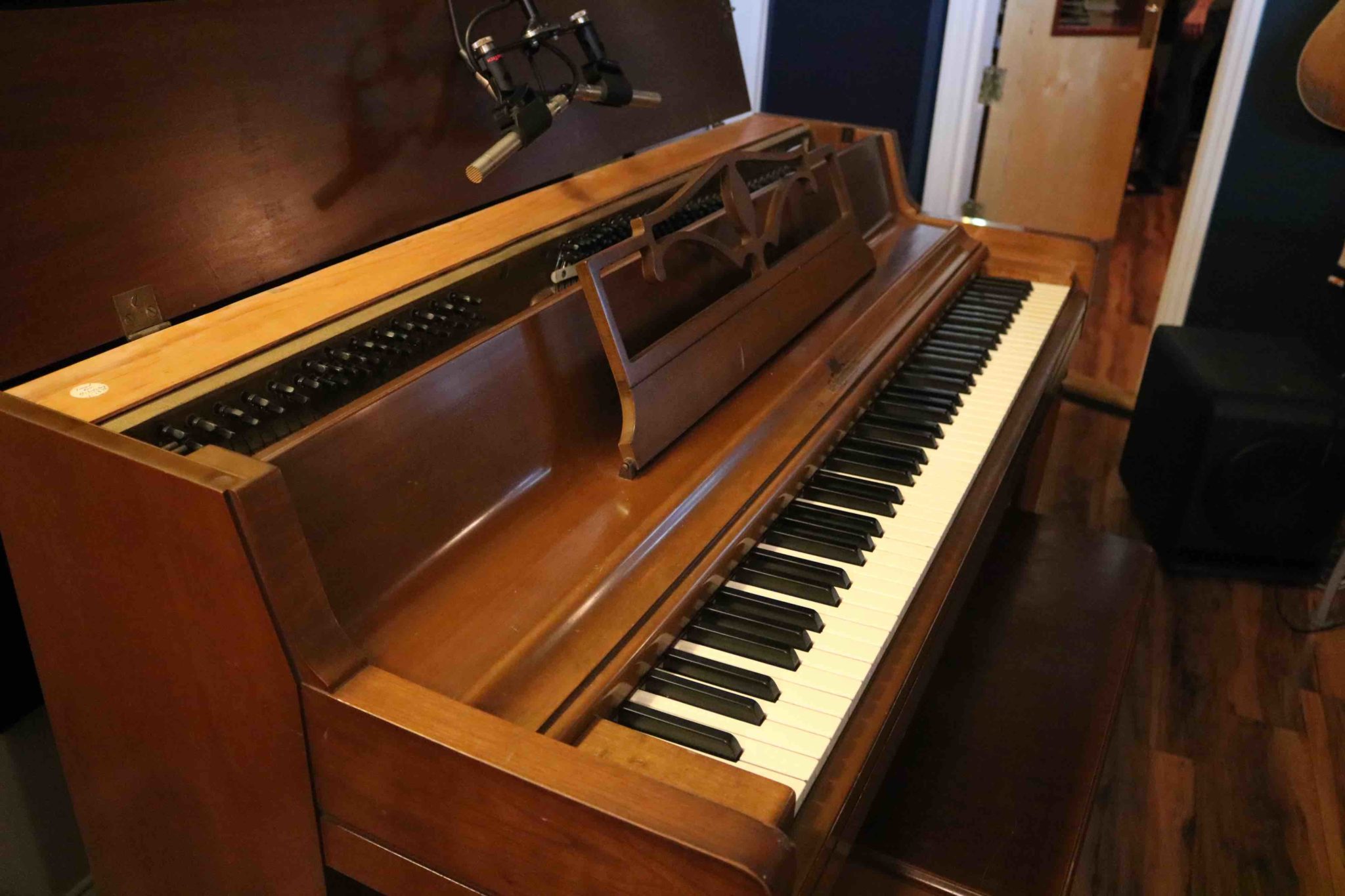
The mighty upright!!! Formerly owned by Nashville session player Chris Tuttle.

Rachel Platten Wildfire Tour:   Part  2  (The effort required to prepare for a Tour)

Rachel and her team flew me out to LA the 3rd week of Feb to sit in on rehearsals for 3 days and help coach Rachel during her full set to get the highest level of vocals and maintain the vocal health we’d been regaining (via many Skype and some live sessions) over the previous months.  Rehearsals were held at the world famous SIR Studios in Hollywood.  SIR is like walking around a Rock and Roll Museum. Halls of guitars, basses, amps, drums, horns and assorted other instruments in glass cases winding through a space with several rehearsal studios that have been home to God only knows how many Rock legends preparing for tours and recording sessions.

Rachel had been gearing up for this tour for almost a year by traveling all over the world promoting Fight Song.  Putting together a big show for a hit record is no small undertaking, and I applaud Rachel, her band  (Chris Anderson, Craig Meyer and Rebecca Haviland), her personal assistant Clarissa Savage, her manager Ben Singer, and the rest of her team for really stepping up to the plate.

On top of getting the full set together to promote the release of the Wildfire CD, Rachel had been gearing up to ad a lot of dance choreography to the show.  She was working with Paul Kirkland on choreographing dance moves and stage direction for the tour.  She was loving that aspect of the show and you could tell.  She’d been telling me for weeks how much she was enjoying dancing.  The only drawback was, that while learning some fairly difficult dance moves, she was still attempting to sing full out.  It was important to find a method that would allow her to practice the new moves and not tire her voice out.   The microphone was placed by the keyboard.  The songs where Rachel sang and played keyboards at the same time needed to be slightly altered so that she could focus a bit more on the vocals.  This is the beauty of playing with a great band, they can pick up the slack and give the singer some more freedom.  But when Rachel stepped away from the keys and worked the stage she had her hands full with the new dance moves.

As the days wore on, it was clear that Rachel’s mind was often on the choreography and her voice was getting tired.  We were very intent on her not hurting her voice, so we worked together on a few techniques that would allow her to practice the dance moves and not cause any wear and tear to a voice that was basically working 7 days a week.  I won’t go into giant details here, but it’s very important to have the ability to work through vocal material at a variety of energy and projection levels.  With material that covers a lot of vocal range, this can be easier said than done.  So sometimes learning to practice at less demanding levels requires a fair amount of practice in and of itself.  Well fortunately, Rachel and I have worked together for many years and can communicate through a myriad of possible singing techniques.  We would switch it up quite a bit to keep it effective.  A couple things we’d alternate into the equation were using tongue rolls and lips rolls with the melodies of the songs during the choreography.  If you’ve checked out any of my study material, you’ll see that I’m very specific about how to do those exercises, so suffice it to say, if you’re pushing through those exercises, they won’t actually help you avoid the strain we’re looking to alleviate.

This tour was very well planned and lots of great people were involved in putting it together and making it great.  Something Rachel is great at, is listening to the ideas and opinions of everyone involved and trying out several options to reach the very highest level possible.  Something to take into mind is how much energy it costs to try out every option you can.  To literally try the suggestions from those involved takes time and lots of effort.  It’s a testament to what it takes to do things at the very highest level.  Not a small feat.

And smack dab in the middle of rehearsals, her publicity department had scheduled a run of about 5 consecutive interviews.    This took a huge tole on her energy and rehearsal momentum.  It’s hard to switch gears so many times a day and still have any focus left.  Rachel had over worked the day before the interviews and even after a full day of band rehearsal, had stayed late and practiced more dance moves.  Unfortunately she kept singing through this extended stay at a very high energy level, and tired herself and her voice out.  After the second interview you could hear the fatigue in her voice and we needed to find a secluded place in the rehearsal facility and get her voice back to a healthy place.  There we were, out on the loading dock of Sir studios doing some vocal recovery techniques to get her voice centered and back in the right place to continue the day.   Once we got her voice back in alignment, the rest of that day, and the rest of the rehearsals went awesome.

Rachel is very strong, and very disciplined, and in the end always pulls it off.

Tune in next time for Part Three of the Wildfire tour.

Filed Under: Singing Blog

Bruised Larynx!!!!

July 28, 2016 by Breck Alan

Bruised Larynx!!!!

Linda M.
Anchorage, Alaska

My toddler accidentally  head-butted  me in the throat and now I can’t
even talk without discomfort, much less sing. Very disconcerting! I
have a performance scheduled in a month. Do you know if it
should be better by then?

Breck:     You should probably be fine in a few days. If it’s still within the first 24 hours I would ice it like any other trauma with swelling. Crushed ice would work best. The larynx is like a little box of cartilage woven together by muscle tissue. Unless you really damaged the structure of this you should be fine when then swelling goes down and the bruising subsides. I would go to a health food store or natural pharmacy and get some Arnica. It’s magical for bruised and damaged tissue. If you fear you might have damaged the structure of your larynx, then you do need to see a doctor!!! I understand how scary that is for a singer. I won’t allow anyone to even touch my throat.
The answer to when you can sing again depends a lot upon how good your singing habits are. If you’re not a singer with great finesse then I would probably wait for about a week. If you have great control, then you’ll know when.

Filed Under: Articles on Singing

Vibrato

July 21, 2016 by Breck Alan

Vibrato

Terry Coleman, Boulder, Colorado:    Is the vibrato learned through the technique using slow to faster pulsing a “real” vibrato,” or is it contrived? Could using this technique do harm? Is there a better way to develop the vibrato and is it true that other ways take a very long time?

Breck:       Once long ago as a youngster I was in Berlin pre unification. Like all tourists I had one thing on my mind – the Berlin wall. I asked a local person how I could find it and she grumbled, “don’t look for the wall. It will find you.” Years later I asked a great voice teacher Peter Elvins how to get vibrato. He said something reminiscent of the crotchety Berliner, “don’t worry about your vibrato. It will come when it’s ready.” It took me awhile to understand what he meant but it did eventually become clear. When you focus on good tone production, vibrato becomes a natural element that falls into place. The vibrato I teach to singers is something I call “Open Body Vibrato.” This true vibrato is a natural balance of breath and resonance. It is possible only when a singer is capable of an open, unforced and sustained tone. When you sing a well placed, non airy sustained tone practice patience first. Listen to this tone and begin to make adjustments. This is best done when a singer has a good understanding of how resonance and placement work. The first place to focus on placement is at the post nasal position inside your mouth. This is right where your uvula hangs down. This is what I call the “Anchor” in singing and is basically the sound board of the voice. This is the beginning of resonance for the voice after the initial pitch and tone created by the vocal cords. All other resonance from the nasal passage, the mouth and the chest is attached to that initial placement. If you are well-Anchored and your support system (breath control) is even and not pushy, you will begin to hear the vibrato happening naturally. Because this true “Open Body Vibrato” is a type of echoing effect of the resonance in your body it is adjustable by making slight changes in resonance. If you direct your resonance upwards towards your nasal passage, it will become faster because that is the smallest resonance chamber. Conversely, if you direct your resonance more into your body (chest) it will slow down because that is the largest resonance chamber. Does this kind of vibrato take more time and patience then the type you described in your question? Yes it does. But it’s worth it because it’s real and when a singer finds it through this kind of process there are so many other things that come to them along the way.
The technique you described is indeed capable of causing harm if you are creating too much pressure on your vocal cords and larynx. And yes, this type of vibrato sounds very contrived and phony. Singing is largely about conveying emotion, and as in any type of communication honest emotion is desirable. That said I always maintain that anything a singer tries as long as it doesn’t hurt him/her is fair game. A huge part of learning and continuing to enjoy any instrument is in experimentation and discovery. So if you are careful with it, you might find some interesting embellishments that you enjoy.

Have patience, the slow way is the fast way.

Filed Under: Articles on Singing

  • 1
  • 2
  • 3
  • …
  • 5
  • Next Page »

This error message is only visible to WordPress admins

Error: No feed found.

Please go to the Instagram Feed settings page to create a feed.

The Art of Body Singing with Breck Alan

Free Video Voice Lessons

Free Video Voice Lessons

Sign up for Body Singing Email List


powered by MailChimp!

© 2026 · bodysinging.com ·